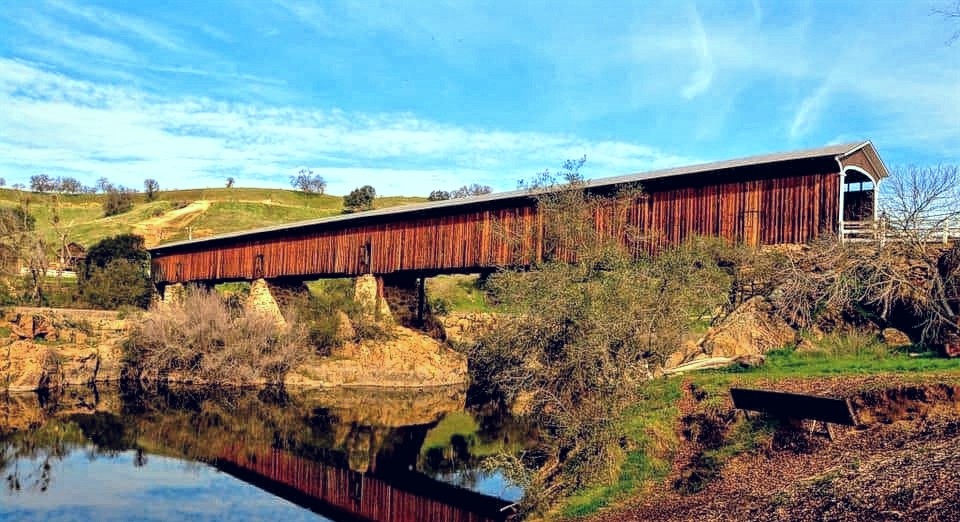
Knights Ferry sits at the edge of the foothills where the Stanislaus River flows out of the Sierra and into the Central Valley, and it might be the single best morning hike within an hour of Modesto, Stockton, or Turlock. The trail is flat, the scenery is dramatic, and you don't need special gear or serious fitness to enjoy it. Just a pair of sneakers and an early alarm clock.
The Covered Bridge and the Story Behind It
The first thing you'll notice is the covered bridge. Built in 1863, it's the longest covered bridge west of the Mississippi at 330 feet. It was originally constructed by the U.S. Army as part of a military road connecting Stockton to the southern mines. The bridge survived floods, neglect, and a fire in 2007 that damaged the far end, which has since been restored. Today it serves as the trailhead and photo op that kicks off your morning.
Walk through the bridge and you're immediately on the north bank of the Stanislaus. The river here runs clear and cold year-round, fed by New Melones Dam just upstream. In spring the water is a deep green; by summer it turns turquoise in the shallows where granite boulders break the current into pools and eddies.
The Boulder Fields
About a quarter mile downstream from the bridge, the trail opens up to enormous granite boulder fields that slope down to the river. These aren't small rocks — they're car-sized slabs of smooth granite, warm in the sun, perfect for sitting, picnicking, or just watching the water flow past. Kids love scrambling over them, and the spaces between the boulders create natural shelters from the wind.
The boulders were left behind by glacial action thousands of years ago and smoothed by centuries of river flooding. They create a landscape that feels more like the Sierra high country than the valley floor — which makes sense, since Knights Ferry sits right at that geological transition zone where foothill meets flatland.
Bird Watching Along the Stanislaus
Knights Ferry is quietly one of the best birding spots in Stanislaus County. The riparian corridor along the river supports a surprising diversity of species. Great blue herons stand motionless in the shallows. Red-tailed hawks circle above the oak canopy. In spring, you'll hear acorn woodpeckers hammering away in the valley oaks, and if you're patient, you might spot a belted kingfisher diving for small fish in the clear pools.
The combination of oak woodland, river, and open grassland creates overlapping habitats that draw species you wouldn't normally see in any single environment. Bring binoculars if you have them — the tree canopy along the trail is active with warblers, flycatchers, and western bluebirds from March through June.
Wade Spots and Swimming Holes
From late May through September, the Stanislaus runs low enough to wade in several spots downstream of the bridge. The water stays cold — typically in the mid-60s even in August — thanks to the dam releases upstream. But on a 100-degree valley afternoon, that cold water is exactly what you want.
The best wade spots are where the boulders create natural pools with sandy bottoms. Look for areas where the current slows and the water turns from rushing white to glassy green. These pools are typically thigh-deep at most and safe for confident swimmers. The Army Corps of Engineers manages water flow, so levels are relatively predictable compared to free-flowing rivers.
Tips for Families
Knights Ferry is one of those rare hikes that works for every age group. Toddlers can splash in the shallows while grandparents rest on sun-warmed boulders. The trail itself is stroller-friendly for the first half mile (packed dirt, mostly flat). Beyond that, it narrows and roots make it better suited for walking feet. Dogs are welcome on leash, and most mornings you'll see more golden retrievers than people.
The Bottom Line
Knights Ferry doesn't require an REI membership or a training montage. It's a walk along a beautiful river with a historic bridge, enormous boulders, and clear water that feels like it belongs in the Sierra rather than 20 minutes from the valley floor. For the effort-to-reward ratio, there's nothing else like it in the 209. Get there early, bring a towel, and leave your expectations of what a valley hike can be at the trailhead.
Explore More Trails in the 209
We've mapped hiking trails, nature walks, and foothill adventures across the Central Valley.
View All Hiking Spots →